| AdelaideRadio first opened on 1st October 1912 with the callsign POA (Post Office Adelaide), which was later changed to VIA.It was the sixth coastal radio station built in Australia and the last of the capital city stations. The station was located on Rosewater about 2 km from Port Adelaide. Power for operation of the plant was provided from the 400-volt town supply stepped down to 200-volts at 50Hz. No standby power plant was provided. In 1914 Adelaide was one of a network of 19 coastal stations reaching right around the continent including stations at Broome, Thursday Island, Cooktown and Flinders Island. |
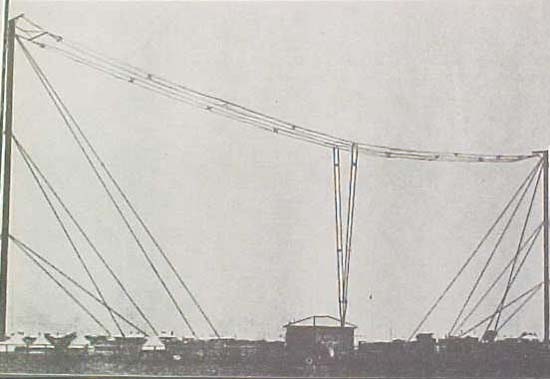
VIA Circa 1919
In
order to provide staff to operate stations as they were commissioned
throughout the country a notification
Later, positions were advertised for staff in The Professional Division for Engineer-Operators. A position of Engineer Operator Class F for Adelaide was created and advertised in the Gazette of 3rd July 1911. A staff of three operated the facilities between 8.am. Midnight. Traffic to and from the State telegraph system as well as time signals was handled via tie lines linking the station with the Adelaide General Post Office and the Observatory. The receiver originally installed was known as a Type 3 set employing three crystal detectors wired to a three-position switch to allow any one crystal to be selected. Many forms of crystals were used at VIA before the introduction of the vacuum tube. Bornite and zincite combination, silicon, galena and specially prepared iron pyrites were all used with satisfactory results. Each operator used what he fancied. The VIA transmitter had a good range and was usually the first station heard by ships coming south from Japan and Hong Kong. In 1923 when the "Changsha" hit a reef near the Philippines, VIA was the first station to pick up and answer the SOS call. Mr. Hugh Taylor one of the radio operators on the "Changsha" later worked at VIA. In
1912 a new Navigation Act made it compulsory for every foreign going
ship, Australian built ship or ship engaged in coastal trade carrying
50 or more persons, including passengers and crew, trading in Australian
waters to be equipped with apparatus for wireless telegraphy. These
included 20 Government vessels and ships operated by the Adelaide
Steamship Company. Ships working AdelaideRadio were equipped with
a variety of apparatus, mostly supplied by Marconi or Telefunken. |
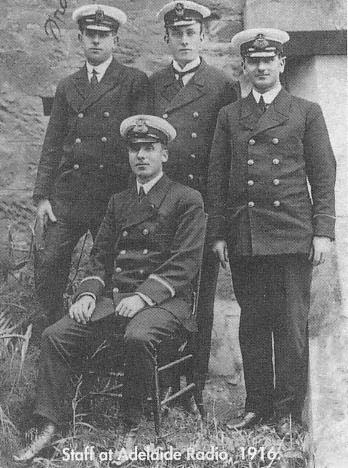
|
The Wireless Telegraphy Act was amended on 6th September 1915 to enable administration of the Act to be transferred to the Navy Department. Effective from 1st October, the Coastal Radio Service was organised on Naval lines and under naval discipline. The local VIA staff were taken on Naval strength. The Officer in Charge was given the rank of Commissioned Telegraphist, the next in charge, classified as Warrant Telegraphist, and the others became Petty Officers. The positions, which the staff occupied, in the Radio Telegraph Branch of the Post Office were abolished under the Commonwealth Public Service Act. The Officer in-Charge was also Radio Inspector in South Australia for the Navy and was frequently called upon to investigate unauthorised stations or suspicious signalling. On 11th November 1918 Warrant Telegraphist E.H. Smellie who had taken up duty as Acting Officer in Charge of VIA on 1st December 1917 led a procession of 100 naval personnel on a victory celebration march in Adelaide. There will be more on Mr Smellie at the end of my report. The Royal Australian Naval Radio Service was disbanded on 28th October 1920 and on the following day staff were transferred back to the Post Office. From 27th October 1920 the Postmaster General's Department resumed control. The Post Office took immediate steps to plan for upgrading of facilities. Tube type transmitters had by then become readily available and decision was made to replace inefficient spark systems. Specifications had been drawn up for new facilities to be provided and funds set aside. However, in 1921 a proposal that Amalgamated Wireless (A/Asia) Ltd. take over the Coastal Radio Service in the Commonwealth was under consideration and a decision was made to defer the upgrading work until the question of Government policy had been settled. The Coastal Radio Service had been far from profitable. In 1920/21 revenue for AdelaideRadio was only £988 while the cost of operating and maintaining the station amounted to £1943. Throughout Australia the network was operating at a loss of some £60,000 per annum. (How many times through the years have we heard that song played ?) In 1921 the Regulations were amended to include requirement for ships over 1600 tons on the Australian Register to carry wireless telegraph equipment. At the same time, positions of Radio Inspector were provided for Sydney, Melbourne and Perth. The Adelaide position was established in January 1924. The first office of the Wireless Branch was situated on the corner of Grenfell and Twin Streets. After a short stay it was transferred to Pirie Street, just behind the Stock Exchange building. I believe that site is now occupied by the 23-storey Telstra building. It was later moved to the G.P.O. main building where it remained for a number of years before being transferred to Post Office Place. After a stay of about 15 years it was again moved, and has since had many more addresses. In 1922 an agreement provided for the transfer to AWA of the operations of the Coastal Radio Service and for the company to develop services to overseas countries. The company was to take over all radio stations operating at the time excepting those wholly controlled by the Department of Defence, existing personnel of the Government radio service were to be taken over by the company, pension rights and retiring allowances being preserved. Control by AWA of VIA Adelaide was effective from 8th May 1922 When AWA took over the station, VIA was operating a continuous commercial ship service with time signals at midday and midnight S.A. standard time, and weather forecasts. The original spark transmitter was still in service and the receiver comprised a Commonwealth standard type with a wavelength range of 200 to 20,000 metres for tube or crystal detector. Broadcasting stations 5CL and 5DN were both in operation by 1925 and station listeners were increasingly complaining of interference from the spark transmissions. On 4th October 1925 an ICW transmitter was installed which greatly improved the efficiency of transmissions from VIA but also cleared up the complaints when spark transmissions ceased on 22nd October 1925. |
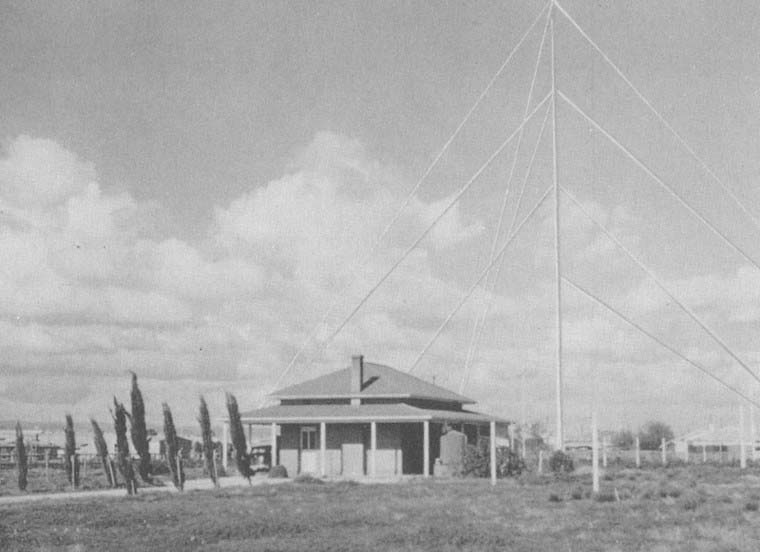
VIA Circa 1930s or 1940s
The original antenna system was still in use in 1925 but some time later
a fire damaged one of the
Oregon members and the whole installation was replaced with steel tubular
type supports.
About the time that the new transmitter was delivered improved receiving apparatus was provided. Regenerative type receivers made by AWA were put into operation and together with the transmitters the new facilities resulted in a great improvement. In 1927 Beam Wireless equipment was installed at Rosewater during November and a 5kw transmitter operated on wavelengths of 17.36, 19.88 and 50 metres. A radiotelephone service from VIA with small ships belonging to the Adelaide Steamship Co. was inaugurated during August 1929. The first ship fitted with wireless equipment was the "Mulcra" and service started with her on the 17th August. Service was conducted initially on wavelengths of 800 to 200 metres. During May/June 1937 arrangements were made for Parafield airport to use the facilities at VIA for direct two-way communication with aircraft. Equipment to allow this form of communication was installed at VIA and connected by landline to Parafield. In 1945 a Commonwealth Telecommunications Conference was held in London and decision was made that each of the Commonwealth countries should assume public ownership of radio and cable installations and services in its own country. In June the following year the Australian Government gave expression to this agreement and created a new corporate body, the Overseas Telecommunications Commission (Aust) to be responsible for the maintenance and operation of telecommunications services between Australia and other countries, with ships at sea and between Australia's external territories. The Government on 1st October 1946 purchased the coastal radio stations and services from AWA. Under a Caretaker and Management Agreement, the company continued to operate the services on behalf of OTC for some four months whilst the new Commission completed its organisational arrangements. OTC assumed full control of the radio services on 1st February 1947. Most of the company's staff at the coastal stations transferred to similar positions in the new organisation so that the stations continued to be manned largely by the same people. During 1947 facilities were introduced at all coastal radio stations to provide radiotelephone communication with small ships in Australian coastal waters. This small ships service was still operating in 1993 making possible the exchange of telegrams in addition to providing a vital SOLAS (Safety of Life at Sea) service. Initially only one frequency was used for this service. Later, all stations, in addition to the international distress frequency 2182 kHz, employed three frequencies in the 2, 4 and 6 Mhz bands. VIA kept a continuous loudspeaker listening watch on three frequencies including the distress frequency. Weather reports and navigational warnings were broadcast on two of these frequencies. Local noise and interference became a major problem at the original site due to industrialisation of the area and in 1952 some of the Rosewater receiving facilities were transferred to Brighton. The receivers and antennas were located in the yard of Minda Home, Brighton and the receivers were remotely controlled from Rosewater. Signals were fed over telephone pairs to the operating position. A small concrete building housed the receivers and a buried copper plate was put down for an earth system. In 1963 a new coast station centre was established at McLarenVale some 40km south of Adelaide on a site of about 66 acres. The rapid industrialisation of the Rosewater area had increased electrical interference to the point where a move to a new site became imperative. The time was opportune too, to increase the power of the main transmission and to provide added and more modern facilities. The McLarenVale site was chosen because it was within reasonable distance of Adelaide; it was protected by land barriers unlikely to be developed industrially and therefore relatively immune from electrical interference and the site was adequate for all transmission and reception facilities as well as for future expansion. The station was the first of a new style in Coastal Radio Service facilities. Five new houses of attractive design were built in the McLarenVale district to accommodate staff. Sir Giles Chippandall C.B.E. officially opened the station on 29th March 1963 before a small gathering of distinguished guests. |
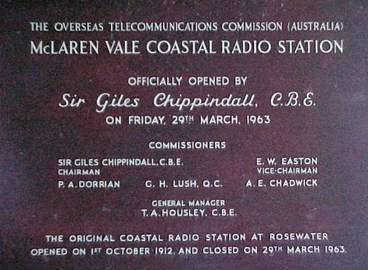
At 12.45 p.m. Mr. T.A. Housley C.B.E. General Manager
of the Overseas Telecommunications Commission addressed guests and introduced
Sir Giles, |
The General Manager then announced that the Rosewater Station would make its final call. At precisely
1.00 p.m. Mr. H.S. Taylor transmitting on 6410kHz announced: The first contact McLarenVale made was with the "Maltara". This was then followed by contacts with the "Troubridge", Neptune Island lighthouse and the "Orion". The Orion was on her final voyage before being retired after 28 years service. At the time of contact the Orion was some 960 km west of McLarenVale. Mr. Hugh Taylor, who sent the last message from Rosewater, started in radio in 1916 when he was trained at Sydney Naval Station. He spent some 18 years at sea. He joined the Island Radio Service in New Guinea in December 1936 and VIA staff in 1942. While in New Guinea Mr Taylor served at RabaulRadio and was there when the Rabaul volcano erupted in 1937. Transferred to Manus Island in 1938 and with a handful of European men remaining made a precarious escape ahead of the invading Japanese army in early 1942, taking with them radio equipment previously hidden at remote points on the island. On making landfall at Bagabag Island, north of Madang, was informed by PortMoresbyRadio that the Japanese were in control of Madang and they should proceed to Bogajim, south of Madang, and then trek on foot 300 miles inland to Mount Hagen. This order was duly obeyed and Mr Taylor manned remote radio stations en-route. |
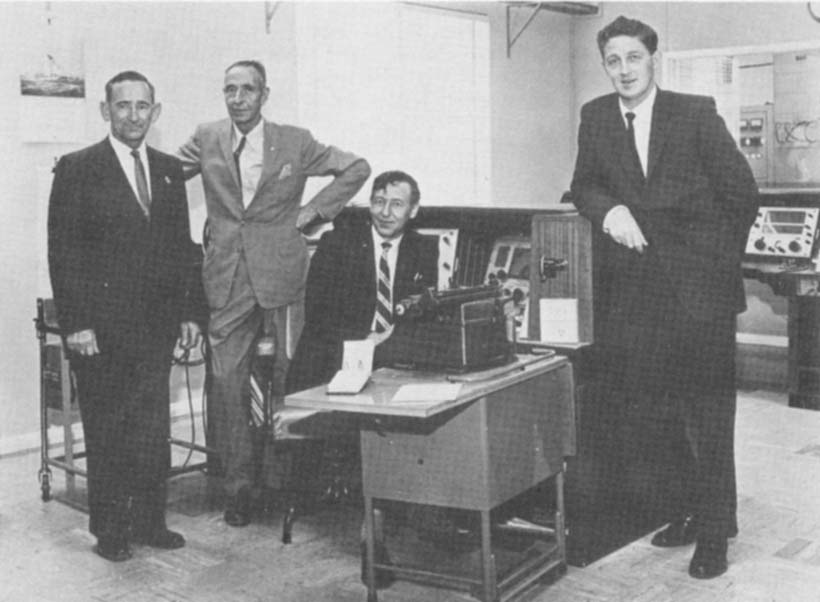
Mr H S Taylor, Mr EJ O'Donnell OIC, Mr D Bartlett, Mr J Tweddle
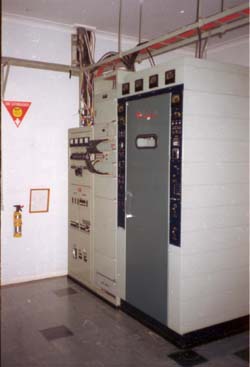
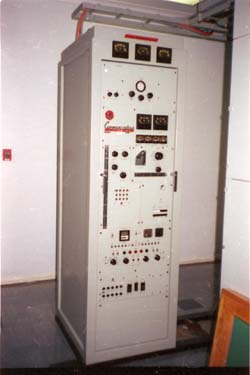
The Rosewater staff at shut down became the first staff at McLarenVale. A Mr J Fuge, not included in the above photograph, was also a staff member. Mr. O'Donnell had been Officer in Charge of AdelaideRadio since October 1958 and was previously stationed there in 1923-1925. With a lifetime spent in the Coastal Radio Service he retired two months after the new station opened. Mr. Taylor then took over as Officer in Charge, followed by Mr. Banks, and then Mr. M. Lang who retired in 1979 and handed over to Mr Fred Reeve who remained until the station closed down in 1993. It should be mentioned that Mr O’Donnell also served many years in the Islands and spent 18 months at Port Moresby during the 2nd World War. Max Lang also served in Port Moresby between 1942 and 1943. The book SeaWatchers (the Story of Australia’s Coast Radio Service) by Lawrence Durrant details the exploits of these men in Papua New Guinea As described earlier the site selected for the new station was some 40km south of Adelaide. Situated in the McLarenVale wine district. Magnificent views were to be seen from the operating room windows – the Southern Mt Lofty ranges, Gulf of St Vincent at AldingaBay. To the south were many almond orchards that were spectacular when in bloom during mid winter. Sadly, almonds are being pulled out and replaced with more vineyards. McLarenVale area is now a “wall-to-wall” vineyard The facilities provided at McLarenVale included the most modem types of transmitters and receivers available and in the intervening years the equipment had been replaced or upgraded to ensure a high standard of efficiency. By 1975 transmitters were operating with output powers between 300 and 2000 watts using AWA types CTH P5J, CLH IL and CTM 2k. These fed into a wide range of antennas including a vertical fan type with three 30 metre wire elements, a quadrant, an 18 metre vertical dipole, a 50 metre top loaded mast with radial earth mat, a 130 metre long wire antenna as well as various standby types. In the late 1970’s three 1Kw AWA ATS1 transmitters were installed for small ship and HF working and the CLH-IL was retired |
 |
 |
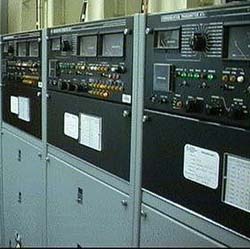 |
| CTM2K (2KW TX) |
CTHP5J (500W TX) |
ATS1 (1KW TXs) |
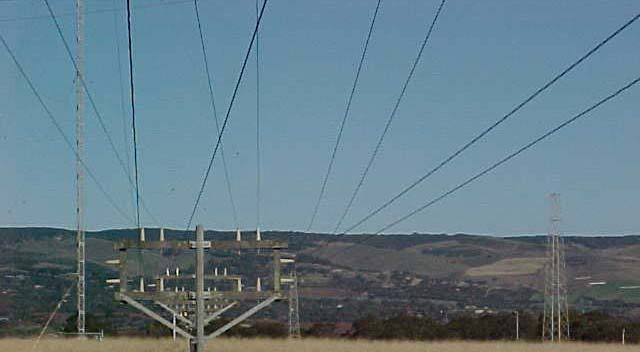
Open wire transmission lines fed all antennas, except
the 50 metre top loaded mast, which is fed by 75-ohm coaxial cable. |
When I joined the station in 1978 work went on at a leisurely pace but from the early 1980’s it picked up very dramatically when an International fax bureau was installed at the station. The Radphone service greatly improved with the introduction of direct dialling by the VIA operators and a manual VHF R/T service started. The Fax service required contacting a switchboard in Sydney and asking for connection to the overseas destination and was therefore very manpower intensive. With two operators on duty one would start off a radphone call and then jump over to the W/T desk and handle a few telegrams. In the meantime the guy on fax would run over and shutdown the Radfone circuit and start up the next call, while the fellow on W/T would give an ‘AS’ and race across to service the fax etc etc etc. Fred Reeve used to refer to his operators “bouncing off the walls”. During single operator periods you could equate the person on duty to a totem tennis ball at the end of an elastic string. At some point it was decided to move the two consoles from line astern formation to side by side so that one man could more easily roll his chair between the two operating positions. |
|
Time-consuming and labour |
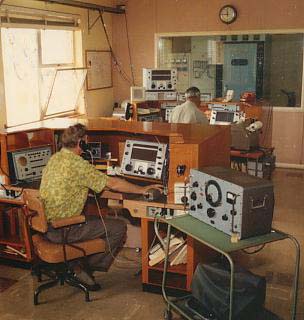
Operating room, consoles line astern. Power unit, Antenna patching and CTM-2k Tx can be seen through window in TX room. Max Lang seen near camera & Denis Maher on W/T point. |
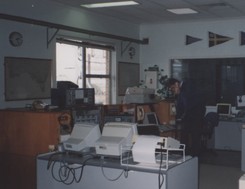
Operating room, consoles side by side. Radfone console
nearest to camera, with table holding VHF seaphone equipment. |

|
Traffic used to be taken directly onto a point-to-point teletype machine connected directly into the Adelaide GPO. The GPO operators would then forward on to final destinations. Around 1980 we were fitted with a TRESS machine (I cannot remember what the letters stood for – something like Telegraphic routing enhanced switching system). The VIA ops would now punch out the incoming traffic onto 5-unit tape and then run that directly into the TRESS machine after punching in the final destination code thus cutting out double handling at the GPO and speed up traffic delivery. Beginning in the mid 1970’s OTC began training operators to the same standards as the older R/Os but with no licence to operate ship stations. After serving time at SydneyRadio some were sent to AdelaideRadio to round off their skills. One of those operators, Denise Jones, later joined ANARE and worked at Australia’s Davis base in the Antarctic where she met husband to be and married in an ice cave. By the mid 1980s most new ships were fitted with radiotelex and/or Satcoms and the VHF Seaphone service became automated, fax machines became part of the furniture in all offices and operator workload just dropped off. By the early nineties most of us did not bother to plug in our morse keys unless a ship called on 500khz which was a very rare occurrence by then. AdelaideRadio closed
at Midnight, 31st of January 1993. John McGregor, the longest serving
operator, sent the final signals from the station. |
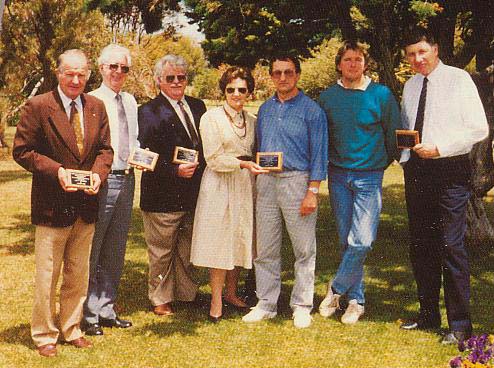
Staff
members at closing ceremony holding individual plaques presented by the Cruising Yacht Club of South Australia. |
|
From left to right: These staff greatly appreciated the functions in their honour presented by the Cruising Yacht Club and the Royal South Australian Yacht Squadron. Other staff who have worked at VIA since 1963 either fulltime or relieving and are not already mentioned in the text include: • Mr G Denson Mr F E Jacvides Mr R Imrie Mr D Mace I extend apologies
to any others whose names I may have overlooked. |
I would like to relate an amusing incident that occurred during one winter sched. I had spent about 10 minutes broadcasting gale and storm warnings for South Australian coasts and ocean waters. It was also the practice to send warnings issued by the Perth bureau because South Australian weather originates from the west. After I had finished the warnings I called for any ships that wished to report in. One of the fishing boats came up on 4mhz. “AdelaideRadio this is Jolly Roger - Myself and two other boats are sheltering in Western River Cove on the north coast of Kangaroo Island. We heard your warnings but thought we would doublecheck. When we eased our noses outside the first wave took us so high we could see you over there in McLarenVale so we turned right around and ran for cover, over”. My reply suggested they had made a very wise decision. Something similar to “If you were smaller than Queen Mary then you should not be playing outside today.” (Name of the fishing boat has been changed)
When Lawrie Durrant was compiling data for his book The Seawatchers in 1984, Mr Smellie then aged 91, produced his profile of a sparky and if one considers the conditions under which the early radio men in Australia, NewGuinea and the other islands served they were certainly Jacks of all Trades. Compared to the push-button communication systems of today those old operators were supermen. Definition of a Coastal Radio Service Radio Telegraphist
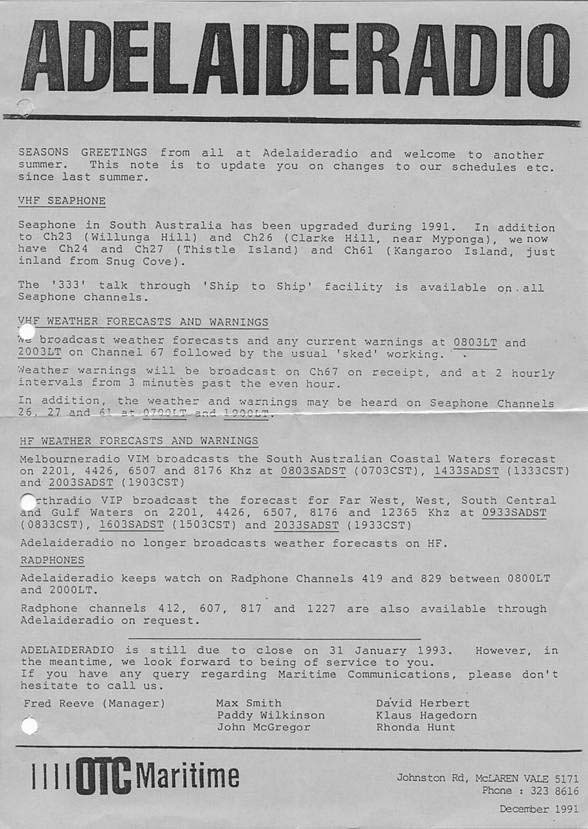
The document below was distributed to yacht clubs, volunteer rescue squadrons and retailers in the boating industry and is how the new owner became aware that AdelaideRadio was closing down |
VIA has not completely disappeared. Radio ham Harro Krause/VK5HK and his wife Yvonne/ VK5YK purchased the site, complete with antennas and some equipment. They have converted the building into their residence and use the transmitter room as their radio shack.
|
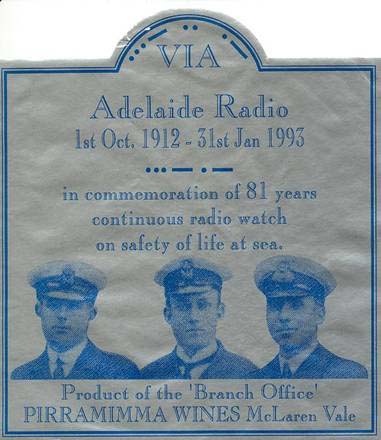
|
Local winery PirraMimma, located across the road from the station, had been known for many years by VIA staff as the branch office. The winemaker there very kindly produced a commemorative port for the occasion. Harro has since sold the 60-acre aerial paddock back to the winery while he can still use the antenna systems. Vines will probably be planted over the next few years. When you have crook fruit trees it is common to spray them with copper-oxychloride, hence the copper earthmat should help to produce some magic grapes. Watch out for “Aerial Shiraz”, “Radio Red”, “Wireless White”, “Old Ether Port” or something similar in your local bottle shop. 1st October 2002 will be the 90th anniversary of the commissioning of VIA. Sad to say the remaining Australian coast stations finally closed on 1st July 2002. Marconi’s technology has certainly matured. Will they ever need sparkies on space ships ? |
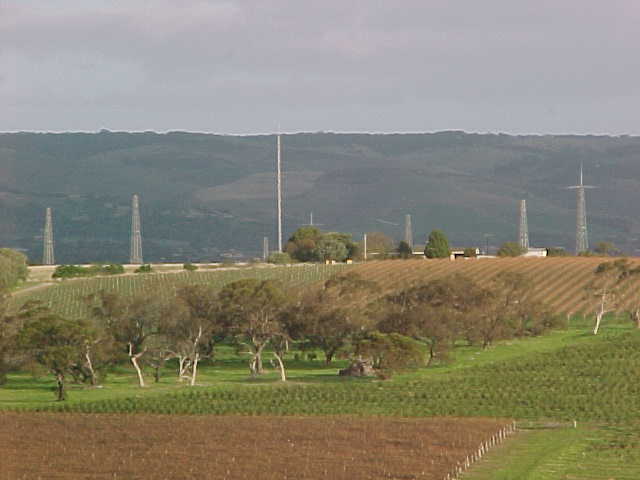
VIA as it is today surrounded by vineyards – Circa2002
Bibliography: Durant L. The Seawatchers:The Story of Australia’s Coastal Radio Service. North Ryde 2113, Angus & Robertson. 1986 ISBN 0 207 15198 9 Miller M. Coast Radio calling: A pictorial history of the first thirty-five years of the Coastal Radio Service 1912-1947. Sydney, OTC Australia. 1992 (No ISBN listed) Marsden S A History of Woodville. Published by Woodville Council, ISBN and National Library Number 0 9599828 4 1. http://www.satellite-terminals.com/radio_history Displays a history of Australia’s Coastal Radio and Island Radio services. http://coastradio.info (www not necessary) Reports on Australian Maritime stations with links to other related sites like AMVER & AUSREP services. Recommended reading Lawrie Durrant’s book – The Seawatchers
(See bibliography) The story of VIA, (VK5HK VK5YK and VK5CRS since 1993), will be taken up by Harro Krause and the South Coast Radio Amateur Club |